About this solution
Objectives
1. Become familiar with aeronautical materials and technologies
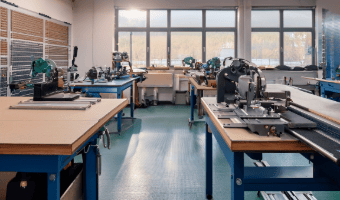
Students learn the mechanical and structural properties of composite materials (resin, fibreglass, honeycomb), using equipment for drilling, cutting, riveting and controlled bench work.
2. Design and represent aeronautical components
Using professional CAD software (CATIA, SolidWorks, AutoCAD), students produce technical drawings and model parts and components, learning 2D/3D drawing techniques and aeronautical nomenclature according to ATA standards.
3. Carry out tests and measurements on materials and joints
The lab provides instruments for mechanical testing (balances, callipers, micrometers, roughness testers, density meters) and kits for checking the quality of workmanship, allowing the operations carried out to be validated.
4. Work safely in a technical environment
Each student has PPE (gloves, goggles, ear defenders, apron), and the room is equipped with bench extractors, tool cabinets, an air filtration system and containers for waste and sharp materials, in line with current regulations.
Learning Aims
1. Acquire practical skills with composite materials
Through tests with real materials and dedicated equipment, students learn to carry out aeronautical machining and assembly work, respecting the required tolerances and structural quality.
2. Apply technical drawing to real production
Training combines CAD software and manual drawing to give students the ability to read, interpret and produce aeronautical technical drawings according to industrial and school standards.
3. Encourage precision and attention to quality
Activities are structured to strengthen operational precision, tool management and the checking of work, promoting autonomy and responsibility in technical and professional practice.
4. Build a culture of safety and environmental awareness
The lab includes all the equipment needed to manage personal and environmental safety properly, making students aware of the importance of complying with regulations and preventing mechanical and dust-related risks.