About this solution
Educational Aims
- Encourage integrated learning of theory and practice in the cereal and pulse supply chain.
- Train professionals able to use machines for milling, processing and quality control of flours and their derivatives.
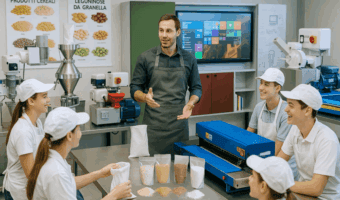
- Offer a realistic lab setting for direct, immersive experience with compact processing plant.
- Raise students’ awareness of traceability, food safety and the sustainable use of agri-food resources.
- Promote the use of digital and interactive tools for training, presentation and management of teaching data.
- Stimulate active, interdisciplinary learning focused on solving real problems in the food sector.
- Support inclusion and accessibility with ergonomic, flexible and technologically advanced environments.
Learning Objectives
- Understand the processing cycle of cereals and pulses, from raw material to finished product.
- Use professional machinery such as stone mills, sifters, pneumatic systems and mixers.
- Observe and assess the physico-chemical characteristics of materials and the mechanical dynamics of milling.
- Acquire skills in flour quality control, including pre-milling processes and particle-size selection.
- Apply notions of environmental sustainability and low-impact supply chains through the use of local produce.
- Take part in experimental activities, research and projects in the agri-food and technology fields.
- Use interactive displays, multimedia libraries and digital spaces for collaborative and creative learning.
- Simulate professional and operational situations with a focus on plant maintenance, cleaning and safety.
- Prepare to work in schools, research laboratories, technical institutes and vocational training.
Conclusion
The lab for producing flours from cereals and pulses is an innovative, compact and versatile learning environment, suitable for schools and research centres. Hands-on experience with real plant, combined with inclusive methods and technologically accessible spaces, helps students enter the agri-food workforce and contributes to promoting local supply chains, sustainability and high-quality technical training.
Other solutions for: