About this solution
Lab Objectives
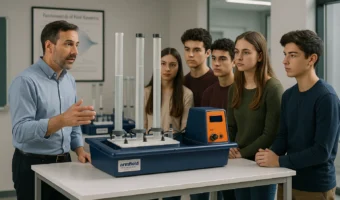
- Analyse upward flow through particle beds o Study the difference in behaviour between fixed beds and fluidised beds. o Observe phenomena such as “bubbling” and changes in flow regime as a function of velocity. o Identify the conditions that lead to the transition between fixed, expanded and fluidised regimes.
- Understand the engineering and environmental applications of fluidised beds o Explore the principles governing packed-bed columns in industrial processes (e.g. ion exchange, catalysis, filtration). o Simulate real processes such as substance extraction, water treatment and fluid percolation through soils. o Analyse the dynamic behaviour of columns fed with air or water at different flow rates.
- Develop skills in measuring and managing flows o Use measuring instruments such as pressure sensors, flow meters and data acquisition software. o Display and record parameters in real time, producing graphs and characteristic curves. o Combine experimental observations with digital data acquired via USB.
Educational Aims
- Link the theoretical concepts of fluid mechanics and mass-energy transfer with practical observations in the lab.
- Build technical and instrumental skills: controlling operating variables, interpreting measurements, managing complex flows.
- Develop the experimental method, from setting up the experiment to collecting and analysing data.
- Raise awareness of the use of granular beds in industrial processes (environmental, pharmaceutical, food and chemical treatment).
- Encourage active learning through activities that combine direct observation, measurement and simulation.
Conclusion
By the end of the lab, students will have: 1. Understood the behaviour of granular beds under upward flow of liquids and gases. 2. Acquired operational and analytical skills in using sensors, flow meters and data collection software. 3. Developed a critical approach to handling experimental data, comparing pressure and flow curves with theoretical models. 4. Gained an applied perspective useful for understanding and designing packed-bed or fluidised-bed systems used in many industrial and environmental sectors. This type of exercise turns complex physical and engineering concepts into real observations, providing a solid foundation for learning about fluidised-bed and fixed-bed processes. This solution includes technology systems that support inclusion and equal opportunities through the use of innovative teaching methods. It is designed to promote active and collaborative learning.
Other solutions for: