About this solution
Lab Objectives
- Study how the main types of chemical reactor work – Analyse the behaviour of batch, continuous and tubular reactors under controlled operating conditions. – Compare the dynamics of slow reactions (batch reactor) with continuous ones (CSTR and tubular reactor). – Observe the influence of variables such as residence time, temperature, mixing and heat conduction.
- Apply the principles of chemical kinetics and process thermodynamics – Determine how reactant conversion varies with reaction time. – Assess the effect of mixing, heat conduction and reactant flow on reaction yield. – Simulate and measure phenomena such as residence time distribution in continuous reactors.
- Acquire experimental and process monitoring skills – Use temperature and conductivity probes to monitor the progress of chemical reactions (e.g. saponification). – Collect experimental data to calculate conversions, reaction rates and mass and energy balances. – Develop the ability to analyse results by comparing theory with lab practice.
Educational Aims
- Turn theory into concrete experience, observing reaction, heat exchange and mixing phenomena in real time.
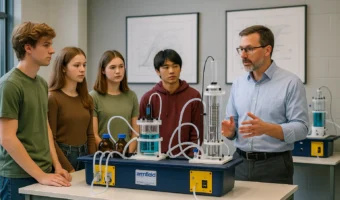
- Build technical and operational skills in using bench-top chemical reactors, measuring instruments and support software.
- Teach the experimental method, from designing the experiment to critically analysing the data collected.
- Prepare for professional work in fields such as industrial chemistry, process engineering, and pharmaceutical and food production.
- Promote safety and responsibility in the lab, with an awareness of the procedures for handling chemical equipment.
Conclusion
By the end of the lab activities, students will have: 1. Understood the operational and application differences between batch, continuous and tubular reactors. 2. Acquired practical skills in monitoring and managing small-scale reaction processes. 3. Developed critical analysis skills, comparing experimental data with theoretical models of chemical kinetics and mass and energy balances. 4. Gained an applied perspective, useful for designing, optimising and managing real chemical plants. This lab bridges the theory and practice of chemical engineering, allowing students to observe and understand complex phenomena under safe, controlled conditions. This solution includes technology that supports inclusion and equal opportunities through innovative teaching methods. It is designed to promote active, collaborative learning.
Other solutions for: