About this solution
Lab Objectives
- Study the dynamics of chemical reactors in series o Analyse the dynamic behaviour of perfectly mixed multi-stage reactions. o Observe how the conductivity of the solution changes along a series of reactors. o Understand the relationship between flow rate, residence time and conversion.
- Determine liquid and gas diffusion coefficients o Experiment with cells specially designed for liquid-phase (honeycomb) and gas-phase (heated capillary tube) diffusion. o Acquire skills in monitoring diffusion over time using conductivity meters and digital technologies. o Analyse the effect of temperature, concentration and pressure difference on diffusion.
- Analyse fluid mixing phenomena o Assess the effectiveness of mixing in stirred vessels, with different impellers and at various speeds. o Study the behaviour of drive torque during mixing. o Monitor fluid homogenisation visually and digitally as a function of the baffles.
- Explore heat transfer in stirred systems o Measure the temperature of fluids inside vessels using heated or cooled coils. o Calculate changes in viscosity and heat transfer performance. o Assess the impact of temperature on chemical reactions or mixing.
Educational Aims
- Develop a practical and theoretical understanding of chemical kinetics and mass transfer through real simulations.
- Train students to use advanced lab instrumentation: stirrers, conductivity meters, temperature sensors, graphing software.
- Encourage the integration of concepts from physics, chemistry and engineering in applied contexts.
- Develop skills in experimental analysis and data interpretation, including with digital tools and automatic acquisition.
- Prepare students for the world of the chemical industry and biotechnology, where mixing, diffusion and thermal control are fundamental processes.
Conclusion
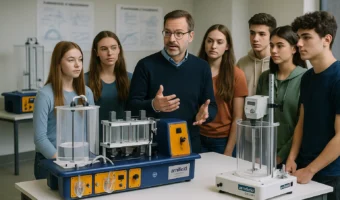
The lab gives students a complete, well-structured pathway through the fundamental principles of mass and heat transfer, reactivity and mixing in fluid systems. The activities allow not only qualitative observation of phenomena but also quantitative data collection and analysis using advanced instrumentation and professional software. By carrying out experiments on diffusion, conduction, mixing and chemical reactions in series, students develop transferable skills useful both for further study and for working in industrial, environmental and biotechnology settings. This lab experience therefore acts as a bridge between theory and practice, promoting high-level technical, scientific and operational training. This solution includes technology systems that support inclusion and equal opportunities through the use of innovative teaching methods. It is designed to promote active and collaborative learning.
Other solutions for: