About this solution
Lab Objectives
- Study the kinetics of batch enzymatic reactions o Analyse the isomerisation of glucose into fructose catalysed by glucose isomerase. o Observe the effect of operating variables such as temperature, concentration and time on reaction rate.
- Develop skills in using optical instrumentation for continuous monitoring o Understand the principle of the optical flow polarimeter for determining sugar concentration. o Interpret the data obtained from integrated digital devices (rotation angle of polarised light, reaction curve).
- Apply process control and automation methods o Use a PID controller to regulate the temperature in the reactor. o Implement an automatic sampling system and real-time monitoring of reactions.
Educational Aims
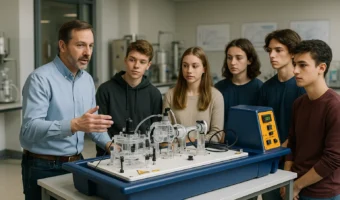
- Explore batch enzymatic catalysis through a teaching plant that faithfully simulates industrial operating conditions.
- Develop familiarity with automated analytical instrumentation, in particular optical analysis devices (polarimeter) and integrated control systems.
- Encourage an interdisciplinary approach spanning biochemistry, chemical engineering and process control, developing the ability to read experimental data critically.
- Get students used to software for recording and representing data, making it easier to manage and interpret experimental information from an industrial perspective.
Conclusion
The batch enzymatic reactor lab is an important learning experience for understanding the basics of biological catalysis, enzyme kinetics and automated measurement techniques. The integration of chemical process, advanced instrumentation and control software gives students the opportunity to work in a setting similar to an industrial one, with a high degree of operational fidelity. The optical flow polarimeter, together with the data acquisition and display system, allows real-time monitoring of the reaction, reducing experimental error and increasing process control. The experience helps participants develop an analytical, engineering mindset, making the lab an outstanding teaching tool for technical and scientific training. This solution includes technology systems that support inclusion and equal opportunities through the use of innovative teaching methods. It is designed to promote active and collaborative learning.
Other solutions for: