Informazioni sulla Soluzione
Lab Objectives
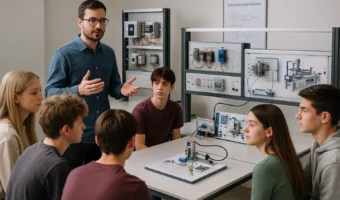
The “Sensor Technology – Fundamentals” lab aims to introduce and consolidate technical skills in the use and programming of sensors in modern industrial applications. The training package is based on a modular, versatile experiment board designed to simulate many real measurement and detection scenarios. The main objectives are:
- Become familiar with how digital and analogue sensors work through practical, progressive exercises.
- Learn to select the most suitable sensor according to material properties, distance, environment and signal requirements.
- Build complete circuits and test the dynamic responses of sensors: hysteresis, reduction factors, reflection, and the influence of vibration and temperature changes.
- Explore the integration of sensors via IO-Link and RFID interfaces, up to simulating real cases of automation, quality control and smart information management.
- Encourage a hands-on approach with material samples and magnetic supports for automated measurement, classification and sorting.
Educational Aims
The lab is structured to guide students through a complete learning pathway, from the physical fundamentals of sensor technology to the implementation of complex, interconnected configurations. 1. Technical and scientific skills
- Understanding the physical principles behind sensors (inductive, capacitive, optical, ultrasonic, Pt100, RFID, encoders).
- Recognising the different types of measurement: absolute, relative, incremental, digital and analogue.
- Developing metrology skills: assessing precision, sensitivity, linearity, switching distance and hysteresis. 2. Design and problem solving
- Planning and carrying out practical experiments on real objects, with a constructive and comparative approach.
- Analysing results to optimise detection parameters.
- Developing skills in signal debugging and reading output data. 3. Automation and interconnection
- Introduction to industrial architectures using IO-Link, PROFINET, OPC-UA and MQTT.
- Simulation of Industry 4.0 scenarios with smart sensors, data traceability (RFID) and digital interface configurations.
- Use of digital support tools (the tec2SKILL® Sensorics augmented reality APP) to enhance immersive learning. 4. Modular, progressive teaching
- A wide range of TechnoCards, application templates and manuals divided into levels (basic, advanced, expert).
- A gradual, scalable approach, suitable for classes with different levels of preparation.
- The option to customise experiments for in-depth topics or interdisciplinary projects.
Conclusion
The “Sensor Technology – Fundamentals” lab is an advanced, flexible teaching platform for training in automation, mechatronics, electronics and industrial maintenance.
Other solutions for: