About this solution
Lab Objectives
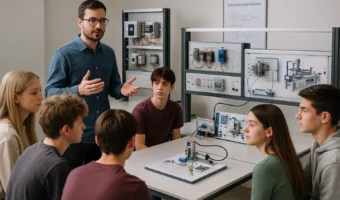
The lab aims to introduce students to the use and management of automated mechatronic test stations for detecting, measuring and checking the physical and geometric characteristics of workpieces. The main objective is to simulate real production environments where advanced sensor technology plays a key role in monitoring and in the quality of the industrial process. By assembling and using dedicated modules, students work with:
- Inductive, capacitive, optical, laser, ultrasonic and colour sensors
- Analogue and digital measurement technologies
- Standard industrial communication interfaces (M12, SUB-D)
- Automation systems (e.g. S7/300C)
Learning Aims
1. Technical and operational skills
- Developing skills in installing, configuring and using different types of industrial sensors
- Learning the operating principle of each technology (e.g. induction, optical reflection, ultrasound)
- Designing and carrying out tests for detecting and classifying workpieces (shape, colour, height, distance) 2. Integration into automation systems
- Connecting and configuring sensors via standard interfaces for interaction with PLC control boards
- Acquiring data from analogue and digital sensors
- Evaluating signals and interpreting them for automated decision-making 3. Critical thinking and troubleshooting
- Comparing different sensor technologies in terms of precision, field of application and limitations
- Analysing and resolving anomalies or inconsistent signals
- Developing strategies for optimising automated quality checks
Conclusion
The lab dedicated to test modules for automated mechatronic stations is a dynamic, interdisciplinary learning environment where mechanics, electronics and computer science come together. Through the use of smart sensors and their integration into automated architectures, students:
- Understand the automation logic of quality control
- Develop the ability to design scalable, modular inspection and test systems
- Experience in practice how modern mechatronics meets the requirements of Industry 4.0. The lab thus trains technicians able to work in highly automated environments, with a solid grounding in sensor technologies and transfer and control systems. This solution includes technology systems that help promote inclusion and equal opportunities through the use of innovative teaching methods. It is designed to promote active and collaborative learning.
Other solutions for: