About this solution
Objectives
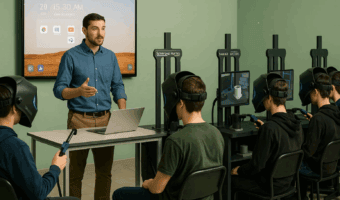
The lab combines immersive simulation and advanced digital tools to ensure safe, sustainable and inclusive technical training in welding.
- Develop practical welding skills using a virtual/immersive simulator able to handle the main processes: SMAW, MIG/MAG, TIG and FCAW.
- Ensure safe and sustainable learning, eliminating the typical risks of real welding and reducing material consumption.
- Enhance interactive teaching with a teacher station equipped with a Google EDLA-certified interactive display, educational software and tools for centralised content management.
- Provide tools for monitoring and assessing student performance through the tracking, reporting and cloud management features of the simulator and the interactive whiteboard.
- Foster collaboration and inclusion in the classroom, with stations and content accessible to all students in real time.
Aims
The training programme combines theory and practice in a technologically advanced environment that complies with safety and sustainability standards.
- Combine theory and practice in a single learning environment, allowing a quick move from explanation to simulated exercise.
- Prepare students for the world of work by providing up-to-date technical skills in line with industry standards and the latest technologies.
- Optimise training time and costs by reducing material waste and the set-up time of real exercises.
- Meet safety and sustainability standards, in compliance with the DNSH principle and good environmental practice.
- Support innovative teaching with integrated digital tools, encouraging active and participatory methods.
Conclusion
Made up of the multimedia teacher station and the virtual welding area, the lab represents a modern, safe and sustainable model of technical training. Combining immersive technologies (VR/AR), real-time monitoring systems, advanced educational software and centralised management tools makes it possible to offer a complete training pathway, from interactive theory to simulated practice. Students develop practical skills while reducing risks and costs, tackling the challenges of real industrial settings with greater confidence and efficiency. This configuration includes technology designed to support inclusion and equal opportunities, promoting active, collaborative learning.
Other solutions for: