About this solution
Lab Objectives
- Study the fundamental properties of fluids o Determine parameters such as density, viscosity, atmospheric pressure, capillarity and buoyancy. o Understand how these properties affect the behaviour of fluids under static and dynamic conditions.
- Analyse the behaviour of fluids in motion o Apply Pascal’s and Bernoulli’s principles to relate pressure, velocity and flow rate. o Observe phenomena such as laminar and turbulent flow using the Hele-Shaw apparatus. o Study how pressure and velocity profiles vary using Pitot tubes.
- Understand how hydraulic machines work o Analyse the characteristics of pumps (in series and in parallel) and Francis turbines. o Calculate the performance and efficiency of hydraulic machines according to operating conditions. o Assess the effect of layout and load on pumps connected in series and in parallel.
Educational Aims
- Make the theoretical concepts of hydraulics and fluid dynamics tangible through hands-on experience.
- Develop experimental skills: using measuring instruments such as pressure gauges, flow meters, Pitot tubes and digital data acquisition systems.
- Encourage scientific observation: recognising and describing the fluid-dynamic phenomena observed in the experimental models.
- Build familiarity with the experimental method: planning tests, collecting and processing data, and comparing results with theoretical values.
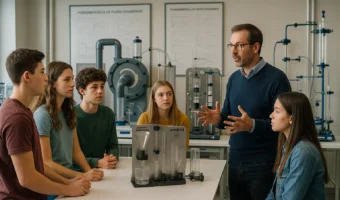
- Encourage collaborative learning: group work, discussion of results and writing technical reports.
Conclusion
By the end of the lab, students will have:
- Consolidated their theoretical knowledge of the properties and behaviour of fluids.
- Gained first-hand experience with professional equipment, understanding the importance of calibration and accurate data acquisition.
- Observed complex fluid-dynamic phenomena, such as changes in velocity profiles, potential flow and head losses, relating their observations to theoretical principles.
- Developed an applied understanding of hydraulics, useful for analysing and designing real hydraulic systems and machines. This lab is a key element of technical education because it combines theory, experimentation and practical applications, giving students skills they can use in industrial and engineering settings. This solution includes technology systems that help foster inclusion and equal opportunities through the use of innovative teaching methods. Designed to promote active and collaborative learning.
Other solutions for: