About this solution
Lab Objectives
- Study the behaviour of moving fluids o Analyse the main fluid dynamic quantities (flow rate, velocity, pressure, head losses). o Apply Bernoulli’s equation and the continuity equation to interpret fluid behaviour in pipes and in variable cross-sections. o Observe phenomena such as the boundary layer, vortices, and flow separation and reattachment.
- Use advanced teaching instruments o Read and interpret data from instruments such as Pitot tubes, nozzles, digital pressure gauges, calibrators and sets of fittings. o Acquire skills in calibrating instruments and recognising measurement uncertainties. o Carry out experiments by varying key parameters (diameter, angles, constrictions, openings).
- Understand the practical applications of fluid dynamics o Link the phenomena observed to real hydraulic and pneumatic systems. o Assess the efficiency of pipes, constrictions and bends on the basis of measured head losses. o Develop an analytical approach to solving technical problems related to fluid transport.
Learning Aims
- Consolidate theory: turning the concepts studied in class (Bernoulli’s equation, continuity, pipe resistance) into practical experiences.
- Train observation and scientific reasoning: recognising visible fluid dynamic phenomena (vortices, free jets, losses) and linking them to measured values.
- Develop technical and lab skills: connecting fluid circuits, reading digital and analogue instruments, and managing pressurised systems.
- Teach experimental methodology: planning experiments, collecting data in an orderly way, analysing results and discussing possible sources of error.
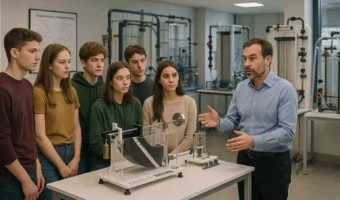
- Encourage collaboration: working in groups, sharing observations and producing complete technical reports.
Conclusion
By the end of the lab, students will have:
- A clear understanding of the fundamental phenomena of fluid dynamics: they will be able to explain, with concrete examples, how pressure and velocity vary in pipes and fittings.
- Acquired operational skills: they will be able to carry out experimental measurements of flow rate, pressure and head losses with professional instruments.
- Understood the importance of fluid system design: they will be able to assess design choices (bends, constrictions, free outlets) in terms of efficiency.
- Developed a critical mindset: they will be able to compare experimental data with theoretical values, identifying any discrepancies and explaining their causes. This lab provides a solid foundation for future study and design of fluid dynamic systems in the industrial, energy and environmental fields. This solution includes technology systems that help promote inclusion and equal opportunities through the use of innovative teaching methods. It is designed to promote active and collaborative learning.
Other solutions for: