About this solution
Lab Objectives
- Study the behaviour of fluids in pipes and open channels o Observe and measure hydraulic phenomena such as channel flow and changes in level and velocity. o Analyse the effect of sluice gates, siphons, weirs and baffle blocks on flow. o Assess pressure and velocity distribution in different configurations.
- Apply the fundamental principles of hydraulics and fluid dynamics o Test Bernoulli’s principle and the continuity equation under real flow conditions. o Study the behaviour of waves and of steady and unsteady flows in open channels. o Analyse head losses, the effects of flow dividers and the generation of artificial waves.
- Develop skills in measurement and data analysis o Use measuring instruments such as Pitot tubes, manometers and Vernier level gauges. o Acquire experimental data on velocity, flow rate and flow profiles. o Use analysis software to produce graphs and compare experimental and theoretical results.
Educational Aims
- Consolidate theory through practice: make the concepts studied in hydraulics, fluid dynamics and civil/environmental engineering tangible.
- Encourage scientific observation: allow students to see complex phenomena such as waves, siphons, weirs and non-uniform flows.
- Develop technical and operational skills: learn to set up experiments, use measuring instruments and follow safety rules.
- Teach the experimental method: design and carry out tests, record and analyse data, and draw conclusions consistent with theoretical principles.
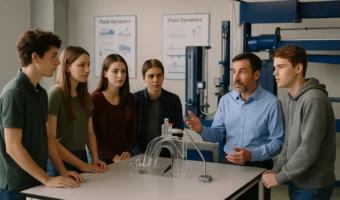
- Promote teamwork: the experiments require collaboration and division of tasks to obtain reliable results.
Conclusion
By the end of the lab activities, students will have: 1. Understood basic hydraulic phenomena such as channel flow, weirs, sluice gates and controlled wave motion. 2. Acquired practical skills in using hydraulic measuring instruments, including Pitot tubes, manometers and data processing software. 3. Developed critical analysis skills by comparing experimental results with theoretical predictions. 4. Gained transferable skills such as teamwork, precise measurement and the ability to write technical reports. This lab offers a complete learning experience, combining theory and practice in understanding fluid behaviour and providing a solid foundation for future study or professional work in civil, environmental and hydraulic engineering. This solution includes technology systems that support inclusion and equal opportunities through the use of innovative teaching methods. It is designed to promote active and collaborative learning.
Other solutions for: