About this solution
Lab Objectives
- Introduce students to programming Siemens S7-1200 PLCs with the TIA Portal software.
- Become familiar with using an HMI operator panel (KTP700) to supervise and control automated processes.
- Design, configure and commission a Profinet network using a 5-port industrial switch.
- Develop practical skills in acquiring and managing digital and analogue signals, with the option of simulation on an A4 board.
- Apply sequential control logic and PID control in simulated industrial scenarios.
Educational Aims
- Provide a complete, interactive learning experience in modern programmable automation, with particular reference to S7-1200 PLCs.
- Develop cross-disciplinary skills in electrical engineering, automation, industrial IT and industrial communication networks (Profinet, AS-i, Profibus).
- Foster an understanding of the project life cycle: from hardware design to programming, through to diagnostics and virtual maintenance.
- Promote student autonomy in configuring and testing automated systems, supported by professional software tools (TIA Portal) and real user interfaces (HMI touch panels).
- Introduce fundamental concepts of operational safety through simulations with emergency stop buttons and power management.
Conclusion
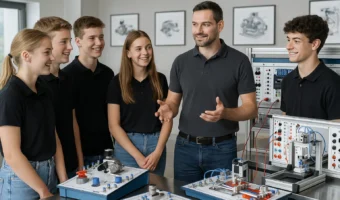
The S7-1200/Touch teaching lab is an innovative, professional learning environment that can faithfully replicate complex industrial scenarios. By combining real hardware, an HMI graphical interface, the TIA Portal software and a wide range of simulated inputs/outputs, students can tackle real design challenges and acquire practical skills they can put to use straight away. The learning pathway also encourages a project-based approach, fostering problem solving, collaboration and independent decision-making: key skills in modern production settings and in work-based learning (PCTO) or entry into technical and industrial employment. This solution includes technology systems that help foster inclusion and equal opportunities through the use of innovative teaching methods. Designed to promote active and collaborative learning.
Other solutions for: