Informazioni sulla Soluzione
Objectives
The programme introduces the principles, installation and diagnostics of residential door entry systems, from single-family to multi-family configurations, with the integration of auxiliary functions.
- Configuration and commissioning
- Assembly, wiring and testing of door entry systems.
- Setting up and functional testing of door releases and stairwell lights.
- Parallel circuits for multiple flats
- Single/two-family topologies and sequential control logic.
- Managing interference and separating system branches.
- Stairwell lighting automation
- Interfacing the door entry unit with a timed stairwell light relay.
- Integration of audible and visual signals.
- Troubleshooting
- Fault finding, measurements and restoring operation.
- Use of technical documentation and wiring diagrams.
Aims
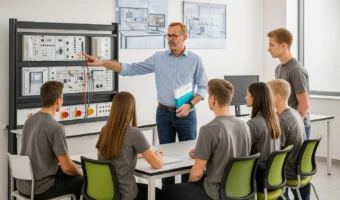
The lab safely replicates real residential installations using photorealistic training modules, protected wiring and a clear separation between low-voltage (12V AC) and mains (230V AC) circuits.
- Understanding systems and components
- Outdoor/indoor units, power supply, actuators (door release, stairwell light), push buttons and indicators.
- AC operation of door phones and chimes; 12V–230V interfacing.
- Practical skills
- Installation and wiring on bench modules with 2/4 mm safety leads.
- Start-up, testing and diagnostics with simulated faults; multi-unit scenarios and remote control.
- Standards and electrical safety
- Applying CEI standards for low-voltage installations.
- Insulation, transformers, galvanic isolation and colour coding to prevent errors.
Conclusion
By the end of the programme, students will be able to:
- Configure, wire and commission a real door entry system.
- Build parallel circuits for multiple flats with sequential logic.
- Integrate door releases and stairwell lighting automation safely.
- Apply CEI standards and work safely at 12V/230V.
- Diagnose and repair simulated faults methodically, with proper documentation.
The lab is ideal for technical schools, vocational training centres (CFP) and ITS: it develops theoretical and practical skills for the electrical installation sector and basic home automation.
Other solutions for: