About this solution
Objectives
1. Develop operational skills in machining
Workshop activities allow students to learn the main manual and machine-tool techniques: turning, milling, welding, drilling, grinding and cutting. Each station is equipped with suitable tools and bench vices for safe exercises.
2. Use precision measuring and inspection instruments
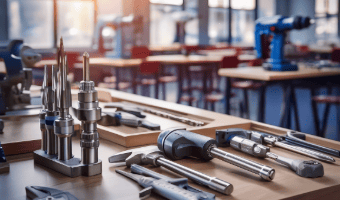
Students learn to use micrometers, callipers, dial gauges, dynamometers and threading kits, developing skills in dimensional inspection and testing of the parts they make.
3. Program and configure mechatronic systems
The lab integrates industrial PLCs, benches for electropneumatics, electrohydraulics and basic robotics, inverters, AC/DC motors and sensors, with hands-on wiring, testing and programming activities using professional software (TIA Portal, FluidSIM, Proteus).
4. Design mechanical components with CAD/CAM software
Each computer workstation is equipped with 2D/3D CAD software (AutoCAD, SolidWorks, Fusion 360) for technical design and functional drawing. Students can model parts, create technical drawings and simulate complex assemblies.
Educational Aims
1. Train technicians ready for the mechanical and 4.0 industry
The set-up supports a complete training programme focused on maintenance, production, programming and prototyping in mechanics, closely aligned with industry standards.
2. Combine theoretical knowledge and practical lab work
Students move from virtual design to the physical production of components, building a deep understanding of processes and a technical problem-solving mindset.
3. Promote a culture of safety and teamwork
Every activity is carried out in compliance with safety rules, with PPE, signage, anti-slip mats and individual lockers. Cooperative work strengthens operational independence and a sense of responsibility for assigned tasks.
4. Experience industrial automation in realistic learning environments
Through home automation modules, PLC-HMI simulations and basic robotic systems, students acquire advanced skills in automation and process integration according to Industry 4.0 paradigms.
Other solutions for: