About this solution
Objectives
1. Develop practical skills in analogue and digital electronics
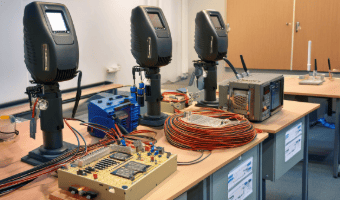
Individual workstations are equipped with regulated power supplies, multimeters, digital oscilloscopes, function generators and ESD devices. Students build circuits on breadboards and PCBs, analysing signals and functional behaviour.
2. Use microcontrollers and programmable development boards
Each student works on Arduino, ESP32, ARM or FPGA platforms, learning embedded programming, how to connect sensors and actuators, and how to integrate them into IoT projects.
3. Apply simulation software for virtual testing
Students simulate circuits with LTSpice, Proteus and Multisim, checking theoretical performance before building them, which encourages an analytical and safe approach.
4. Integrate the use of specialist lab instruments
The lab includes advanced instruments such as spectrum analysers, logic analysers and bench electron microscopes, which are essential for debugging, reverse engineering and analysing complex signals.
Learning Aims
1. Consolidate the design method in electronics
Through progressive exercises, students learn to conceive, simulate, build and test circuits, gaining precision, method and the ability to read schematics.
2. Acquire professional skills in embedded systems and IoT
The pathways guide students in building autonomous systems for control, measurement and communication, with applications in environmental monitoring, automation and electronic prototyping.
3. Work in compliance with ESD and safety regulations
The learning environment is equipped with anti-static mats and gloves, electrostatic discharge devices, fume extractors and PPE to ensure safe operating conditions.
4. Develop technical autonomy and collaboration in projects
Activities are structured to encourage autonomy, individual responsibility and teamwork, with project assignments to be documented, shared and validated according to good professional practice.
Other solutions for: