Informazioni sulla Soluzione
Learning objectives
Introduction to AI – Artificial intelligence, machine learning, deep learning Rule-based AI, machine learning, deep learning – “Supervised learning, unsupervised learning, Reinforcement learning” Concept, classification, regression “Data: Complexity, variance, different objects” “Neurons, weights, network, Network input, activation function Input / hidden / output layer” Overfitting, underfitting – Image processing – Convolutional neural network (CNN) Filter (convolution) – Features – Feature maps – Heat maps – Application Create the training data – Train the model – Test the model – Evaluate the results
Lab Objectives
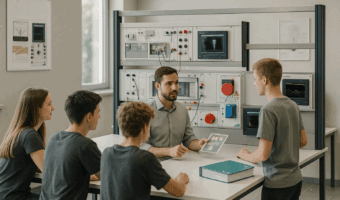
- Provide basic and advanced operational skills in Artificial Intelligence, with particular attention to image processing, visual recognition and data management.
- Introduce students to AI vision systems based on CMOS sensors, autofocus and built-in lighting, similar to those used in real production settings.
- Develop the ability to train and test neural network models, using sample data collected by the camera and validated through user interfaces via a web server and mobile app.
- Explore the hardware and software configuration of embedded AI systems, using industrial protocols (e.g. PROFINET) and standard communication technologies.
- Become familiar with interactive augmented reality learning environments through the Tec2SKILL® ExploreAI app, improving understanding of concepts through quizzes, AR animations and hands-on activities.
Educational Aims
- Consolidate the theoretical concepts of AI (neural networks, propagation, error, validation) and turn them into practical skills through simulations, experiments and the independent design of neural networks.
- Encourage active and cooperative learning, through teaching based on multiple workstations, shared documentation and self-assessment tools for students and teachers.
- Develop a critical, informed approach to the use of AI in industrial settings, analysing the technical, ethical and functional implications of its applications.
- Promote interdisciplinarity, connecting computing, automation, electronics and data science, with real examples of AI use in CPS (Cyber-Physical Systems) stations.
- Support self-directed learning and teaching continuity, through structured materials for individual use (manuals, quizzes, apps) and group use (guided lessons, presentation aids).
Conclusion
The lab on Artificial Intelligence based on computer vision and machine learning is an innovative learning ecosystem, designed to make advanced concepts accessible through hands-on experience. By integrating specialised hardware, interactive mobile apps, augmented reality and structured materials for students and teachers, the course enables immersive, scalable and up-to-date learning. Students will be able to develop solid technical skills and understand the role of AI in the digital transformation of industry and society, laying the foundations for a professional future in highly innovative sectors. This solution includes technology systems that help foster inclusion and equal opportunities through the use of innovative teaching methods. Designed to promote active and collaborative learning.
This product is among the purchases covered by the open calls below: we help your school apply.
- PNRR School Call DM 219-2025: €100 million to set up training hubs for the digital transition on the use of artificial intelligence in schoolsin 58 days
- New PNRR Notice – Scuola 4.0: Integrated Training Campuses for Technical and Vocational Institutesin 58 days
- New ERDF Notice “Scuola e Competenze” 2021-2027: Innovative Labs in Technical and Vocational Institutesin 58 days
Other solutions for:
Related solutions