About this solution
Lab objectives
The lab has been designed to offer a high-level technical and operational environment, with the aim of:
- Acquiring practical skills in using professional kitchen equipment such as combi ovens, pasta cookers, braising pans, industrial dishwashers, blast chillers and refrigeration systems.
- Learning the fundamental principles of hygiene, safety and maintenance in line with HACCP and CE regulations.
- Developing skills in organising and managing kitchen workflow, simulating realistic scenarios in restaurants, hotels and institutional catering.
- Understanding modern cooking techniques: direct and indirect steam, infrared, regeneration, blast chilling and cold storage.
- Promoting sustainable practices through highly energy-efficient technologies with reduced water, energy and detergent consumption.
Educational aims
The educational aims are to train professionals who are ready for the world of work, through:
- A career-oriented pathway leading directly to work as cooks, chefs, kitchen technicians, catering staff and industrial dishwashing operators.
- The use of catering technologies, including digital touch interfaces, automation systems (such as automatic washing and remote control via Wi-Fi) and integrated software.
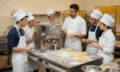
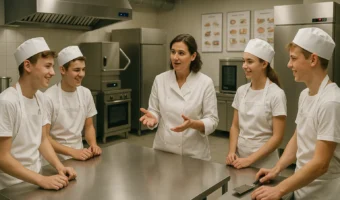
- Promoting teamwork, communication and the allocation of roles, following the model of a kitchen brigade.
- Combining theory and practice through exercises, service simulations and timing analysis, with attention to food safety and quality.
- Support for work-based learning (PCTO, formerly Alternanza Scuola-Lavoro) programmes with highly intensive, technology-rich lab activities.
Conclusion
The kitchen lab is a complete, technologically advanced teaching solution, offering students a real working environment in which to develop skills that can be put to immediate use in the Ho.Re.Ca. sector. With equipment covering every stage of food processing, from cooking to refrigeration and from washing to ventilation, the lab provides all-round training that meets hygiene, safety, ergonomics and sustainability standards.
This teaching infrastructure includes systems designed to support inclusion and equal opportunities, adopting innovative methods and promoting active, collaborative learning.
Other solutions for: