About this solution
Key Learning Objectives
The lab sets out to convey key knowledge of:
- Basic logic circuits, and the properties and characteristics of digital systems.
- Advanced digital components: counters, registers, memories, triggers, ALU.
- Design and analysis of control circuits using digital technology modules.
Lab Objectives
The main objectives of the lab are to:
- Introduce students to the fundamentals of digital technology through the analysis and construction of combinational and sequential logic circuits.
- Develop practical skills in the design, configuration and diagnostics of digital systems and control logic.
- Explore the operation and applications of fundamental components: logic gates, flip-flops, counters, registers, ALUs, A/D and D/A converters.
- Encourage practical, modular learning with trainer boards, teaching overlays, advanced measuring instruments and PC interfaces.
- Combine analogue and digital teaching to understand the shift from analogue to binary logic in modern electronic systems.
Educational Aims
The lab supports many learning aims in electronics, computing and automation:
- Understanding logic fundamentals: basic logic functions (NOT, AND, OR, NAND, NOR, XOR, XNOR), De Morgan’s laws, Boolean algebra and canonical forms (DNF, KNF).
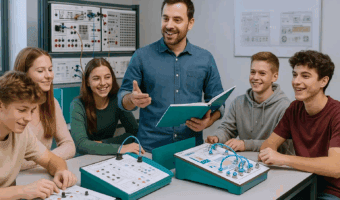
- Circuit design: hands-on construction of combinational and sequential circuits on trainer boards, with LEDs, switches, displays and counters.
- Simulation and analysis: use of integrated instruments such as an oscilloscope, voltmeter and spectrum analyser, connected to a PC via USB to display and interpret digital signals.
- Timing logic: experimenting with circuits using RC modules, flip-flops, shift registers, up/down counters, timer modules and converters.
- A modular, progressive approach: structured learning with boards, graphic overlays and teaching manuals for students and teachers.
- Multidisciplinary training: integrating electrical, electronic and computing concepts to develop logic, problem solving and the ability to work in complex technological environments.
Conclusion
The lab is a modern, complete and highly professional teaching platform for learning digital logic, electronic design and integration with computer systems. Integrated trainer boards, advanced measuring instruments, software and targeted teaching content allow students to move effectively from theory to practice.
This configuration is ideal for technical institutes, ITS, vocational training courses and work-based learning (PCTO), offering an immersive experience that links traditional teaching with digital innovation and prepares future technicians for the challenges of advanced electronics, embedded systems and automation.
The lab includes technological solutions geared towards inclusion and equal opportunities, with the aim of fostering active, collaborative and personalised learning.
Other solutions for: