Informazioni sulla Soluzione
Lab Objectives
Main learning objectives: Using graphical programming methods – Structure and function of microcomputers and processors – Data formats and their conversion – Components of integrated development environments – Programming in Assembler, C, … Firmware generation – Measuring analogue values such as voltage, temperature and pressure – A/D and D/A converters – I²C bus components such as displays, light and temperature sensors – Control of DC and stepper motors. The lab aims to:
- Introduce students to the structure, operation and programming of microcomputers, with a practical focus on the PIC16F887 architecture and its use in embedded systems.
- Provide applied knowledge and skills in C and Assembler programming, using the MPLAB X® development environment and in-circuit debugging systems.
- Develop operational skills in designing the control and regulation systems used in industrial settings, through motor control, sensor management and analogue data acquisition.
- Become familiar with digital and analogue interfaces (USB, I²C, SPI, EIA232) and with A/D and D/A converters, in order to integrate microcontrollers into larger and more complex networks and systems.
- Encourage project-based learning through guided experiments, practical projects and measurement activities, using a complete set of professional instruments for monitoring and evaluating signals.
Educational Aims
The lab provides solid technical and scientific training through:
- Knowledge of microcomputers: in-depth study of the PIC16F887 architecture, memory organisation, CPU operation, registers, ports, timers, interrupts and clock.
- Embedded programming: developing programs in C and Assembler, compiling, simulating and loading firmware onto the microcontroller via the ISP interface and professional debugging tools.
- Developing industrial applications: controlling actuators (DC and stepper motors), handling digital and analogue signals, reading sensors (temperature, pressure, light) and interacting with displays.
- Signal measurement and analysis: using the 4-channel PC measurement interface to monitor voltages, frequencies, transients and signal spectra, with integrated instruments (oscilloscope, analyser, voltmeter).
- Serial and digital communication: implementing communication via I²C, SPI, USB and EIA232 for data exchange between the microcomputer and a computer or other devices, understanding the protocols and register management.
- Modular, progressive teaching: thanks to TechnoCards, graphic templates, student and teacher manuals with CD-ROM and experiment collections, learning is guided, clear and progressive, fostering student autonomy and supporting teaching.
Conclusion
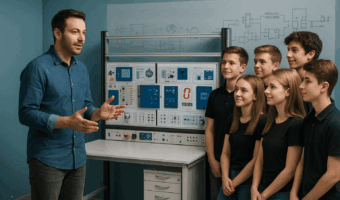
The “Microcomputer technology with µ-Trainer” lab is a complete, safe and professional platform for training in digital electronics, embedded automation and programmable mechatronics. By combining industrial teaching hardware (PIC16F887), professional software (MPLAB®), measuring instruments, plug-in modules and in-depth teaching content, it offers a concrete, multidisciplinary learning experience. This solution is particularly suitable for Technical Institutes, ITS, vocational training providers and work-based learning (PCTO), as it links theory and practice, develops advanced digital skills and prepares students for the technological challenges of Industry 4.0. This solution includes technology systems that support inclusion and equal opportunities through the use of innovative teaching methods. It is designed to promote active and collaborative learning.
Other solutions for: