About this solution
Learning outcomes
The lab provides solid theoretical and practical preparation in electrical protection systems, with particular attention to personal safety. Students will learn about:
- The structure of electrical systems and the assessment of risks from overload, short circuit and overvoltage.
- Choosing appropriate protection in TN-C, TN-C-S, TN-S, TT and IT systems.
- Safety measures according to DIN VDE 0100 and related standards.
- The effects of electric current on the human body and determination of the heart current factor.
- Safety rules and first-response measures in the event of an electrical accident.
- Measures against electric shock and earthing and equipotential bonding strategies.
Lab objectives
The lab is designed to:
- Provide practical skills in analysing electrical faults and how protective devices work.
- Safely simulate electrical hazard conditions, understanding their causes and effects.
- Analyse network systems (TN, TT, IT) and protective devices (RCDs, fuses, earthing).
- Use professional measuring instruments to test and verify electrical protection.
- Understand touch and step voltages and the risks associated with real installations.
Educational aims
The lab aims to:
- Spread a culture of electrical safety through practical simulations and realistic cases.
- Explain the role of technical standards in the design and maintenance of electrical installations.
- Train students to interpret network systems correctly and the protection associated with them.
- Teach the responsible use of measuring instruments and instrument-based verification of protection.
- Develop analytical and practical skills in real technical settings, with attention to personal and collective safety.
- Encourage an experimental approach to learning, with team activities and applied problem solving.
Conclusion
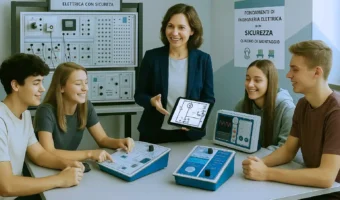
The “Safety Measures in Electrical Engineering” lab is an essential training tool for students on technical and vocational pathways.
Using a low-voltage training station, it makes it possible to simulate realistic electrical hazard situations, understand the effectiveness of protection systems and acquire practical skills.
The activity combines standards, electrical engineering and physics, offering a broad and solid preparation for the electrical installation sector.
The solution is designed for inclusion, active learning and the development of professional skills in electrical safety.
Other solutions for: