About this solution
Learning Objectives
Connecting measuring instruments for current, voltage, consumption and operating hours. Using current transformers to extend the measuring range / for galvanic isolation. Installing remote measuring points, with extended functionality using selector switches
Lab Objectives
- Acquire practical and theoretical skills in industrial measuring instrumentation, with particular reference to contactor control and the use of analogue and digital instruments in electrical environments.
- Develop the ability to read, interpret and configure measuring instruments such as ammeters, voltmeters, frequency meters and energy meters in single-phase and three-phase systems.
- Understand the operating principle of current transformers and measurement selector switches, learning wiring and connection techniques in accordance with technical and safety standards.
- Train students to diagnose electricity consumption and analyse how installations operate through data monitoring and the technical documentation provided.
Educational Aims
- Provide a solid foundation in applied electrical engineering, preparing students for the design, maintenance and control of switchboards, distribution lines and industrial installations.
- Combine theoretical knowledge and practical skills through guided experiments and teaching simulations that reproduce real measurement and control scenarios in the energy and industrial sectors.
- Promote a hands-on approach and competence-based teaching, making students active protagonists in their learning through individual and cooperative activities.
- Prepare students to use technical instruments correctly, developing precision, method and awareness in the analysis of electrical parameters.
- Support work-based learning (PCTO) and professional certifications in fields related to automation, industrial maintenance, energy efficiency and home automation.
Conclusion
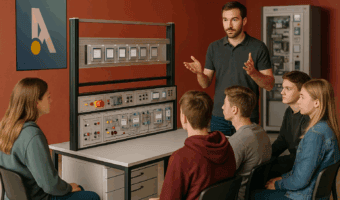
The Contactor Control IV – Industrial Measuring Instruments lab is a complete teaching resource of a high technical standard, designed to introduce students to measurement technologies in electrical and electrotechnical settings. Thanks to the combined use of real instruments, educational boards, technical transparencies and teaching manuals, the lab allows students to explore scenarios involving the reading, analysis and management of electrical parameters safely, tackling topics that are fundamental to the training of industrial technicians, electricians and maintenance technicians. The integration of modular panels, current transformers, digital instruments and network selector switches enables progressive, interactive learning in line with the training standards required in the automation and power distribution sectors. A lab that bridges the gap between theory and practice, fostering concrete, flexible preparation that can be put to use immediately in the world of work. This solution includes technology systems that support inclusion and equal opportunities through the use of innovative teaching methods. It is designed to promote active and collaborative learning.
Other solutions for: