About this solution
Learning objectives
- Troubleshooting electrical machines
- Measurements on electrical machines
- Faults and their documentation
Lab Objectives
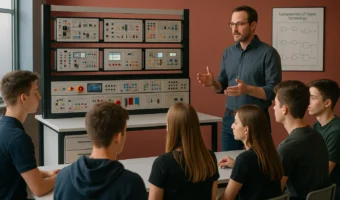
The Motor Fault Simulator lab is designed to give students and trainee technicians direct experience of diagnosing faults in electric motors, with the aim of:
- Simulating real fault conditions safely and under control, in order to develop the skills needed to recognise and resolve electrical anomalies.
- Training in the use of measuring and test instruments in school or vocational training settings, simulating complex scenarios without risk to people or equipment.
- Understanding the electrical behaviour of a motor in the presence of faults, by observing altered electrical parameters and their effects on overall operation. The types of fault that can be simulated include:
- Winding interruption
- Inter-turn short circuit
- Phase-to-phase short circuit
- Insulation failure due to overvoltage
- Frame fault (earth)
Educational Aims
The educational aims of the lab focus on developing diagnostic, technical and practical skills that are essential for professionals working in electrical maintenance, industrial automation and building services. In particular:
- Develop the ability to recognise and classify electrical faults in three-phase motors through abnormal electrical signals, instrument measurements and the interpretation of symptoms.
- Consolidate knowledge of how electric motors work internally and of the role of insulation, phases and winding integrity.
- Train in systematic troubleshooting, using exercise sheets that require identifying the fault and describing the diagnostic procedure.
- Encourage critical reasoning and an understanding of the operational consequences of each fault, including from the point of view of electrical safety and continuity of service. The equipment includes student and trainer manuals, colour graphic cards, CD-ROMs with experiments and binders for organising teaching, making the training highly structured and easy to replicate in class.
Conclusion
The Motor Fault Simulator is an essential training tool for preparing students for real electrical maintenance situations, providing a safe environment in which to test their analysis, measurement and diagnostic skills. By reproducing common faults in electric motors and allowing practice with standard identification and resolution procedures, the lab fosters operational autonomy and strengthens the ability to intervene effectively on malfunctioning electrical systems. The training package is therefore valuable support for technical teaching in electrical engineering, industrial maintenance and automation, helping to train aware, competent technicians ready to face the challenges of modern electrical diagnostics. This solution includes technology systems that help foster inclusion and equal opportunities through the use of innovative teaching methods. Designed to promote active and collaborative learning.
Other solutions for:
Related solutions