About this solution
Learning objectives
- Fundamental laws of electrical engineering
- How to use an oscilloscope and a multimeter
- Passive components in DC circuits
- Capacitors and inductors in AC circuits
- Three-phase current systems
- Voltage-, temperature- and light-dependent resistors
- Semiconductors
- Operational amplifiers
Lab Objectives
- Introduce the fundamental concepts of electrical engineering through structured experimental activities.
- Give students a solid understanding of the fundamental laws of electric current, voltage, resistance and power.
- Develop practical skills in using electrical measuring instruments (multimeters, oscilloscopes, function generators).
- Build the ability to analyse and interpret DC and AC electrical circuits.
- Introduce the properties and behaviour of semiconductors and active components (diodes, transistors, thyristors).
- Understand how electric motors, transformers and three-phase circuits work and how they are applied in practice.
Educational Aims
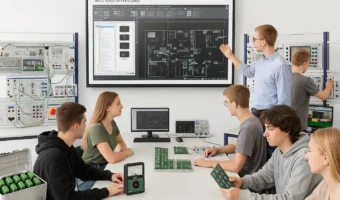
- Active, hands-on teaching: through the direct use of training panels, plug-in modules and graphic templates, students learn through an experiential, participatory approach.
- Interdisciplinarity: the lab brings together physics, mathematics, electronics and automation to build a systemic view of electrical engineering.
- Soft skills development: working in groups on real exercises encourages collaboration, problem solving and time management.
- Preparation for the world of work: the exercises simulate realistic professional technical settings, giving students skills they can use straight away in industrial, craft and specialist technical fields.
- Inclusiveness: thanks to its modular structure and visual tools, the course is also accessible to students with different learning styles and levels of preparation.
Conclusion
The “Principles of Electrical Engineering” lab is an essential starting point for basic technical training in the electrical sector. Through a practical, step-by-step approach, students gain a concrete command of electrical phenomena, developing the ability to analyse, build and test real electrical circuits. The wide range of components, measuring instruments and teaching aids creates a dynamic, complete learning environment with a strong vocational focus. This lab not only lays the theoretical foundations of the subject but also encourages their application in real operational settings, supporting students on a path of technical and personal growth. This solution includes technology systems that help foster inclusion and equal opportunities through the use of innovative teaching methods. Designed to promote active and collaborative learning.
Other solutions for: