About this solution
Learning Objectives
Determining and understanding the relationship between voltages and currents through measurement, calculation and drawing line diagrams. Examining faults, e.g. a missing neutral conductor, phase conductor or load resistor. Recognising the function of the neutral conductor in a star circuit and determining its cross-section. Structure and function of rectifier circuits. Demonstrating through measurement the formation of harmonics caused by electrical circuits, for example in PCs, motor control devices and energy-saving lamps. Recognising neutral conductor overload due to harmonics. Network analysis
Lab Objectives
“Safety of electrical systems and devices – Neutral conductor overload and network analysis”
- Develop the ability to analyse and understand complex electrical phenomena in three-phase networks, with particular attention to the role of the neutral conductor and the formation of harmonics.
- Learn how to carry out advanced measurements on real electrical networks using network analysers, PC interfaces and oscilloscopes.
- Examine the technical risks associated with neutral conductor overload, especially in the presence of non-linear or unbalanced loads.
- Assess the effects of current and voltage harmonics on power quality and on network components.
- Learn to detect, document and interpret anomalies in electrical power distribution (interruptions, flicker, asymmetries, voltage drops).
- Promote a culture of electrical risk prevention in line with technical and safety standards.
Educational Aims
- Give students the theoretical and practical tools to understand the principles of three-phase current (star/delta connections, phase/line voltage, phase interlinking).
- Train professionals able to diagnose complex electrical faults, assessing the impact of harmonic disturbances and neutral conductor faults.
- Develop a methodical, scientific approach to electrical measurement, using professional instruments and software for data collection and analysis.
- Teach the responsible use of energy, encouraging improvements in power quality and the safety of installations.
- Prepare students to tackle real problems in industrial, residential and building services settings, with practical skills directly transferable to the world of work.
- Strengthen understanding of key concepts such as THD, CF and harmonic spectrum through simulations, oscilloscope readings and software applications.
Conclusion
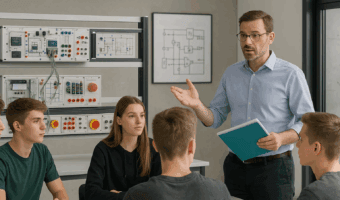
The “Neutral conductor overload and network analysis” lab is a highly technical learning experience, essential for understanding phenomena related to power quality. Using advanced measuring instruments and experimental activities on teaching boards, students learn to detect, assess and solve problems connected with improper use of the neutral, the presence of non-linear loads and the generation of harmonics. The hands-on approach turns complex theoretical concepts into concrete applications, developing critical observation, technical documentation and the adoption of targeted solutions. The learning pathway is aligned with the needs of the modern electrical sector and provides skills that can be applied immediately in installation, maintenance and industrial settings, with particular attention to safety and energy efficiency. This solution includes technology systems that support inclusion and equal opportunities through the use of innovative teaching methods. It is designed to promote active and collaborative learning.
Other solutions for: