About this solution
Lab Objectives
- Understand the fundamental principles of chromatography o Demonstrate the separation of biomolecules (such as proteins) on chromatography columns. o Analyse flow behaviour through beds of different heights to assess separation efficiency.
- Carry out laboratory operations on biological samples o Prepare and treat samples using filtration and degassing techniques before injection. o Use the membrane filter and syringe filtration system to ensure purity and compatibility with the chromatography unit.
- Use instruments for in-line monitoring o Monitor protein concentration with an in-line UV sensor. o Assess the effects of operating parameters (flow rate and height of the chromatography bed) on separation effectiveness.
Educational Aims
- Introduce students to the separation technologies commonly used in the pharmaceutical, food and chemical industries.
- Develop practical skills in handling laboratory instruments, such as peristaltic pumps, UV sensors and fraction collection systems.
- Link separation theory to real physical phenomena, by analysing exclusion efficiency and the dynamic behaviour of columns.
- Promote mastery of good sample preparation practice, including filtration and degassing, to avoid analytical errors.
Conclusion
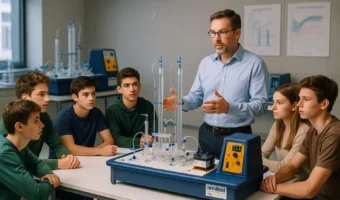
The lab, built around the chromatography unit and the filtration/degassing unit, gives students an integrated view of separation and sample preparation techniques, which are fundamental in the biochemical and pharmaceutical sectors. Through guided experimental activities, participants develop a critical approach to process analysis, learning to control and interpret the operating parameters that affect separation quality. The experience fosters the development of professional skills that can be used in industry, promoting scientific rigour, precision in sample preparation and the ability to work with advanced analytical instruments. This solution includes technology systems that help foster inclusion and equal opportunities through the use of innovative teaching methods. Designed to promote active and collaborative learning.
Other solutions for: