Informazioni sulla Soluzione
Learning objectives
The lab aims to provide a solid grounding in electrical engineering, focusing on:
- Fundamental laws of electrical engineering and their application to circuits.
- Use of measuring instruments: oscilloscope, multimeter and function generator.
- Study of passive components in direct current (DC) circuits.
- Voltage-, temperature- and light-sensitive resistors.
- Operation of capacitors and inductors in alternating current (AC).
- Three-phase systems, transformers and semiconductors.
- Industrial and automotive components: contactors, relays, thyristors.
Lab objectives
The lab aims to provide theoretical knowledge and practical skills in electrical engineering applied to the automotive sector. In particular, it aims to:
- Introduce the principles of electrical engineering, with a focus on DC and AC circuits and the main electrical components (resistors, capacitors, inductors, diodes, transistors).
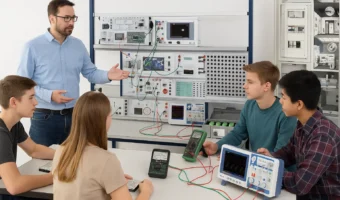
- Have students design, assemble and analyse vehicle electrical systems safely, using plug-in modules, teaching panels and professional instrumentation.
- Understand how automotive electrical systems work: ignition, lighting, power management, motor control and sensors.
- Provide practical skills in using measuring instruments: analogue/digital multimeters and oscilloscopes.
- Introduce students to the concepts of energy efficiency, conversion and automation in vehicle electrical systems.
Educational aims
The lab helps achieve learning objectives relevant to the electrical, mechatronics and automotive sectors, fostering:
- Integration of theory and practice: through experiments that can be carried out safely, with precise and repeatable instrumentation.
- Active learning: based on discovery and solving real problems using industrial components and application cases.
- Critical and analytical thinking: reasoning about electrical configurations, interpreting measurements and evaluating circuit behaviour.
- Collaboration and teamwork: through the simulation of professional environments and shared technical activities.
- Curiosity and innovation: exploring emerging technologies such as sensors, power electronics and digital device control.
Conclusion
The “Principles of electrical engineering – Automotive electrical systems” lab is a modern, complete teaching resource, designed to train students ready to work in electrical design, maintenance and diagnostics in the automotive and industrial sectors.
Through a structured and flexible approach, a wealth of technological equipment and practical activities based on real cases, it builds an effective bridge between school and the world of work. Students will develop the operational skills essential for meeting the challenges of innovation and electric mobility.
This solution integrates technologies designed for inclusion and equity, applying innovative teaching methods and promoting active and collaborative learning.
Other solutions for: