About this solution
Lab Objectives
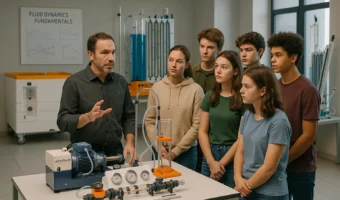
- Study the fundamental principles of hydraulics and fluid dynamics o Analyse the behaviour of fluids in motion and under static conditions. o Understand the relationships between flow rate, pressure and velocity through Bernoulli’s law and the continuity equation. o Observe complex phenomena such as cavitation, free and forced vortices, and the effects of hydrostatic pressure.
- Experiment with how hydraulic machines work o Analyse the operation of variable-speed centrifugal pumps and Pelton turbines. o Calculate parameters such as hydraulic power, mechanical power and efficiency of the machines under test. o Assess how changes in flow rate and pressure affect the performance of hydraulic machines.
- Observe and understand practical phenomena in hydraulic systems o Demonstrate the formation and dissipation of vortices, pressure distribution in tanks and changes in fluid levels. o Study cavitation and its consequences for the operation and lifespan of machines. o Analyse the behaviour of pumps under different load conditions.
Educational Aims
- Consolidate the theoretical concepts studied in class with direct practical experience, improving understanding of the laws of hydraulics.
- Develop experimental skills: calibrating instruments, acquiring and interpreting data on pressure, velocity, flow rate and power.
- Train scientific observation of phenomena such as cavitation and vortices, linking visual evidence to measured values.
- Apply an engineering method: analysing real problems through controlled experiments and simulations of hydraulic systems.
- Encourage collaborative learning: teamwork, managing experimental activities and writing technical reports.
Conclusion
By the end of the lab, students will have:
- Gained a complete view of how fluids behave under both static and dynamic conditions.
- Understood how the main hydraulic machines (pumps and turbines) work and the parameters that affect their efficiency.
- Experimented with and observed complex phenomena such as cavitation, vortices and changes in pressure and level, linking them to theoretical principles.
- Developed practical and analytical skills useful for their professional future: planning experiments, collecting data, calculating efficiencies and critically analysing results. This lab is a fundamental step in consolidating knowledge of hydraulics and fluid dynamics, preparing students for practical application in the industrial, energy and civil engineering sectors. This solution includes technology systems that help foster inclusion and equal opportunities through the use of innovative teaching methods. Designed to promote active and collaborative learning.
Other solutions for: