About this solution
Lab Objectives
- Develop technical skills in industrial pump technology o Explain the operating differences between various types of pump: centrifugal, gear, axial and flexible impeller. o Analyse the fundamental parameters (flow rate, head, efficiency) of pumps under real conditions.
- Carry out dynamic configurations o Configure pumps in series and in parallel to assess the impact on performance. o Measure characteristic curves and hydraulic behaviour with electronic support.
- Learn to use modern instruments o Use sensors, valves, control software, sensorless vector drives and electronic interfaces for data collection and display.
Educational Aims
- Train students in the design and management of fluid systems involving the pumping of liquids in various industrial contexts.
- Consolidate the ability to interpret characteristic curves and calculate power input, hydraulic efficiency and head for different pumps.
- Develop critical thinking in choosing the right pump for the application, through practical comparison of different models.
- Promote direct experimentation and interdisciplinarity, integrating concepts of fluid mechanics, electrical engineering and automation.
Conclusion
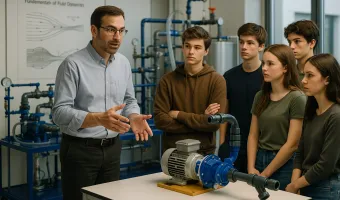
The lab based on the multi-pump bench and its accessory pumps offers an advanced, versatile platform for studying pumping systems. The ability to run up to four pumps at once, in various configurations, lets students explore the theoretical principles they have learned in a concrete way. Through hands-on activities, students become familiar with the hydraulic behaviour of different types of pump, learning to assess and optimise system performance according to the needs of the application. The use of electronic instruments and modular flow management systems brings them closer to the world of modern industrial engineering, preparing them to work in highly specialised technical settings. This solution includes technology systems that help foster inclusion and equal opportunities through innovative teaching methods. It is designed to promote active, collaborative learning.
Other solutions for: