About this solution
Objectives
1. Program and configure industrial PLCs
Students learn to configure real PLCs using software such as TIA Portal or equivalent. They acquire skills in managing digital and analogue I/O, creating structured programs and interacting with field devices.
2. Use human-machine interfaces (HMIs)
Interactive control panels are built using SCADA software (e.g. WinCC), simulating production scenarios and supervising the states of the automated system in real time.
3. Experiment with automation logic and wiring
Using kits of relays, push buttons, terminal blocks and sensors, students develop and test hard-wired logic. Each activity reinforces knowledge of control sequences, electrical safety and commissioning procedures.
4. Apply robotics and actuation techniques
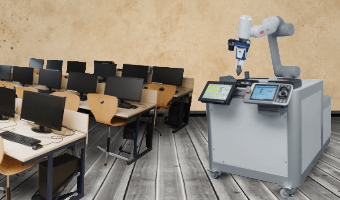
Using dedicated software (RoboDK or DOBOT Studio) and educational robotic arms, students simulate and program movements, production cycles and automated tasks related to collaborative robotics.
Learning Aims
1. Acquire practical skills for industrial automation
The lab allows students to reproduce an automated plant at full scale, developing an understanding of how industrial equipment works, signal analysis and process control.
2. Integrate devices and technologies for control
Activities involve interconnecting PLCs, HMIs, sensors and actuators in multi-technology scenarios to simulate industrial, packaging, logistics and automated production applications.
3. Foster autonomy and diagnostic skills
Exercises include fault and malfunction simulations to develop troubleshooting skills, alarm reading and the use of multimeters, protocol analysers and bench instruments.
4. Prepare students for technical work
The solution is designed to offer a learning experience consistent with the needs of industry, with real software, languages and components, in line with the requirements of Industry 4.0.
Other solutions for: