About this solution
Lab Objectives
- Explore the modes of heat transfer in depth Students gain practical knowledge of conduction, convection (free and forced), radiation and transient heat exchange.
- Analyse the influence of operating conditions The experimental activities make it possible to observe the effects of variables such as airflow, body shape, materials used and thermal regime (steady-state/transient) on heat transfer.
- Use computerised measurement systems and thermocouples Students learn to use data acquisition software, control instruments and devices such as temperature sensors, anemometers, Peltier pumps and PID controllers.
- Compare the thermal conductivity of liquids and gases Through direct experience, students verify the different ability of fluids to conduct heat, strengthening their theoretical understanding of heat capacity and insulation.
- Study measurement errors in thermal applications The accessory for analysing radiation errors introduces the importance of precision in experimental systems, especially in the context of heat transfer with air.
Educational Aims
- Integrate theory and practice in applied thermodynamics Students link theoretical concepts to real applications, consolidating fundamental notions such as the temperature gradient, exchange efficiency and Fourier’s equation.
- Promote the experimental method and autonomy The equipment stimulates observation, hypothesis formulation, experimentation and data analysis, promoting an active and collaborative scientific approach.
- Raise awareness of efficient and sustainable design The use of heat pumps and the assessment of the conductivity of common materials encourage reflection on design choices in the energy and construction sectors.
- Develop technical and digital skills The lab activities involve working with software, advanced measuring instruments and methods that simulate work in university or industrial settings.
Conclusion
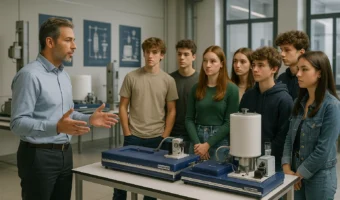
The teaching equipment illustrated — from the computerised service unit for heat exchange to the modules for conduction, convection, radiation and measurement of fluid conductivity — provides a complete, modern set for studying thermal phenomena at school. This solution includes technology systems that help foster inclusion and equal opportunities through the use of innovative teaching methods. Designed to promote active and collaborative learning.
Other solutions for: