About this solution
Lab Objectives
1. Develop technical and practical knowledge of the different types of industrial pumps o Analyse the functional behaviour of centrifugal, gear and piston positive-displacement pumps. o Understand the relationships between speed, head, pressure and flow rate in the different pumping technologies. 2. Carry out exercises on real configurations o Configure pumps in series and in parallel to simulate their use in industrial networks. o Study cavitation, head losses and the dynamic behaviour of the fluid. 3. Use advanced instruments o Use electronic inverters, pressure and temperature sensors and flow control systems for high-precision lab experiments. o Display and record operating data for qualitative and quantitative analysis.
Educational Aims
- Integrate theory and practice in technical education: students learn the fundamentals of fluid mechanics, machines and systems, and apply them with real industrial models at training scale.
- Encourage comparative analysis of pump types: understand the advantages, limits, applications and performance characteristics (e.g. continuous vs. pulsating flow).
- Teach the configuration of complex systems: from a single pump to systems with several combined pumps, independently and critically.
- Provide experience with real automation and control technologies, preparing students for the demands of Industry 4.0 and predictive maintenance.
Conclusion
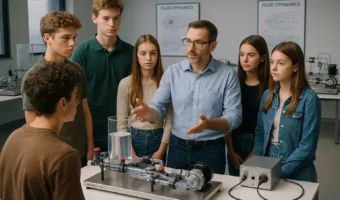
The modular system of demonstration units for different types of pump lets students tackle one of the most crucial topics in industrial plant engineering: fluid transfer. Designed for maximum visibility and accessibility, the equipment allows direct observation of phenomena, independent experimentation and interaction with advanced control instruments. Combining centrifugal, gear and piston pumps makes it possible to explore a wide range of industrial scenarios. The interface unit makes it easy to integrate the various components and makes the lab extremely flexible and adaptable to many training programmes. In short, these units form a complete and indispensable platform for modern technical education in applied hydraulics. This solution includes technology systems that help foster inclusion and equal opportunities through innovative teaching methods. It is designed to promote active, collaborative learning.
Other solutions for: