About this solution
Lab Objectives
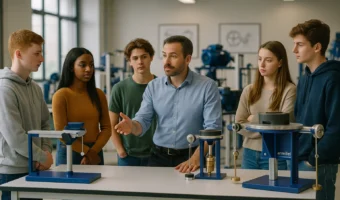
This solution includes technology systems that help foster inclusion and equal opportunities through the use of innovative teaching methods. Designed to promote active and collaborative learning.
- Analyse static and dynamic friction phenomena o Measure and compare the force needed to start and maintain motion between surfaces in contact under varying conditions.
- Understand the role of friction in mechanical components o Assess the efficiency, resisting torque and mechanical behaviour of contact surfaces in journals, clutch discs and bearings.
- Carry out experimental tests on real devices o Apply laboratory techniques to determine friction coefficients under controlled conditions (angle, mass, torque, lubrication).
- Observe the influence of materials and surfaces o Compare the friction generated by different materials (steel, bronze, PTFE, brass) and surface finishes under different conditions.
- Develop skills in measuring torques and forces o Use dynamometers, load hooks, pulleys, calibrated weight systems and tachometers to measure accurately the physical quantities involved in friction.
Educational Aims
- Apply friction theory in technical practice Students consolidate the theoretical concepts learnt in class, working directly with physical measurements and force and torque balance calculations.
- Link physical phenomena to industrial applications The experiments simulate typical operating conditions in industrial plants (e.g. bearing-shaft contact, brake and clutch operation, journal couplings), bringing students closer to the world of mechanical design.
- Encourage learning through experimentation The modularity and accessibility of the equipment allow direct learning in groups, strengthening operational autonomy and the ability to interpret experimental data.
- Train for safety and instrument precision The tests are designed to be safe and intuitive, developing attention to the correct use of instruments and the validation of results.
Conclusion
The friction test equipment provides valuable support for the applied study of mechanics and tribology. Students can analyse with scientific rigour the interaction between surfaces in relative motion and learn about the influence of materials, forces and lubrication. This lab develops key skills for industrial and mechanical technical courses and is particularly useful for those approaching the world of automation, maintenance or mechanical design. The variety of experiments offered ensures a complete, practical and stimulating learning experience, aligned with the
Other solutions for: