About this solution
Lab Objectives
- Understand friction phenomena in transmission systems Students study the forces at work in mechanical transmissions using belts, ropes and brakes, understanding the role of the coefficient of friction in transmitting motion and load.
- Analyse operating and geometric variables The equipment makes it possible to vary: o belt/rope tension; o angle of incidence; o contact surface; o component material; to assess their influence on the friction generated.
- Calculate the coefficient of friction experimentally Using calibrated weights, pulleys, flywheels and load hooks, students acquire skills in measuring forces and determining static and dynamic coefficients of friction.
- Simulate real mechanical working conditions The instruments realistically simulate the operating conditions of typical components in industrial plants and vehicles: V-belts, brake drums, rope on pulley, etc.
Educational Aims
- Explore tribology applied to mechanics Students explore the fundamentals of friction in different contexts: sliding contact (discs, pins), rolling contact (bearings) and mixed contact (belt-drum).
- Develop experimental and analytical skills The tests provide an opportunity to: o set up tests on controlled parameters, o collect torque, tension and motion data, o carry out comparative analysis of different types and materials.
- Encourage engineering problem solving Students are encouraged to identify the causes of variations in results and to propose experimental solutions, such as changing the angle of incidence or the rope/belt tension.
- Link theory and practical applications Theoretical models (e.g. the Eytelwein equation for belts) are verified experimentally, promoting the integration of scientific knowledge and direct observation.
Conclusion
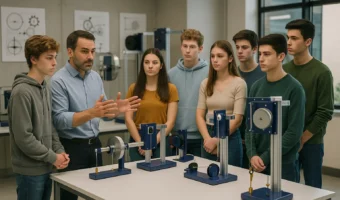
The equipment for friction tests on belts, ropes, drums and brakes is a fundamental component of labs for applied mechanics, mechatronics, transport and logistics, and vehicle maintenance. Through these activities, students:
- become familiar with real technical components;
- learn how to measure and interpret friction forces in different contexts;
- understand the behaviour of materials under load;
- learn to link the performance of mechanical systems to operating and design parameters. These tools make the learning experience more concrete, stimulating and aligned with the skills required in the professional and industrial world. This solution includes technology systems that help foster inclusion and equal opportunities through innovative teaching methods. It is designed to promote active, collaborative learning.7
Other solutions for: