About this solution
Lab Objectives
1. Understand kinematic and dynamic relationships in mechanical systems o Analysis of angular and linear velocity using graduated shafts and masses, highlighting the concepts of leverage, moment and the conversion of rotary motion into linear motion. 2. Study the behaviour of disc brakes o Measure braking torque, normal force and friction, and analyse brake pad materials. Simulate real conditions in a controlled setting. 3. Develop skills in static and dynamic balancing of rotating parts o Use systems of movable masses, pulleys and sensors to simulate mechanical imbalances, determine the centre of mass and reduce vibrations. 4. Explore speed regulation and centrifugal force o Use of speed governors (Porter, Proell, Hartnell) to show the automatic regulation of rotating systems and centrifugal force as a function of mass and speed. 5. Learn about the main mechanical transmissions o Hands-on study of belt, chain, simple and compound gear transmissions (spur, bevel, epicyclic), worm gears and rack and pinion, with the option of varying ratios.
Educational Aims
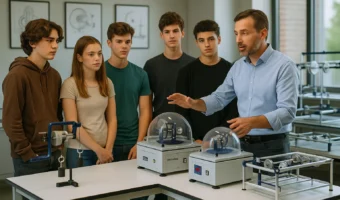
- Encourage experiential learning: students master the fundamental concepts of applied mechanics by directly observing how mechanical systems behave.
- Develop analysis and testing skills: use of real instruments for balancing and adjusting masses, with immediate application of calculations of moment, speed, torque, friction and mechanical efficiency.
- Consolidate professional skills: thanks to interchangeable and configurable modules, students simulate realistic scenarios similar to industrial ones, developing critical thinking and technical problem solving.
- Bring students closer to the world of work: all systems comply with industrial standards and faithfully reproduce the principles used in the automotive, mechanical and building services sectors, making it easier to enter the workplace.
Conclusion
The teaching lab described here allows a complete and effective study of applied mechanics, control systems, motion transmission and dynamic balancing. Thanks to their high degree of modularity and build quality, these units let students interact with realistic instruments and observe physical and mechanical phenomena in real time. The use of sensors, weights, pulleys and movable shafts encourages a direct understanding of the principles, making the learning experience concrete, in-depth and aligned with the needs of modern industry. This solution includes technology systems that help foster inclusion and equal opportunities through the use of innovative teaching methods. Designed to promote active and collaborative learning.
Other solutions for: