About this solution
Lab Objectives
1. Develop an understanding of the mechanics of simple and compound systems: – Analyse the laws of motion, force distribution and mechanical resistance through experiments on the wheel and axle, differential wheel and flywheel. 2. Study motion transmission and the interactions between mechanical components: – Explore how simple and epicyclic gears work, the transmission of circular motion, and speed and torque ratios. 3. Analyse the efficiency and behaviour of threaded systems: – Measure efficiency and friction forces in screw jacks and determine the efficiency of different threads. 4. Understand how cams and followers work: – Record the angular profile of cams, the lift and the law of motion using dial gauges and graphs. 5. Explore front axle geometry in vehicles: – Experiment with camber, kingpin inclination and caster angle on a dynamic model, assessing their impact on vehicle stability and handling.
Educational Aims
- Consolidate theoretical knowledge of applied mechanics: Students can visualise and measure the physical and mechanical principles studied in theory, such as levers, pulleys, threads, friction and moments.
- Link theory to practice in motion transmission: The equipment allows direct analysis of gear systems (linear and epicyclic), making complex phenomena such as gear ratio, angular velocity and efficiency easier to understand.
- Develop experimental independence and measurement skills: Students use measuring instruments such as dial gauges, protractors, force sensors and data acquisition systems to calculate physical quantities directly and precisely.
- Promote dynamic observation of real mechanical systems: The front axle geometry apparatus, for example, simulates real road conditions and is useful for courses in motor vehicle engineering or applied mechatronics.
Conclusion
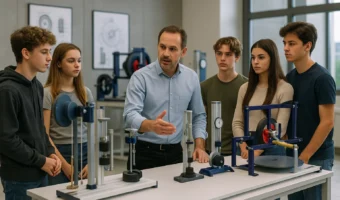
The proposed equipment package offers a complete, highly practical and interactive teaching lab, ideal for Technical Institutes specialising in Mechanics, Mechatronics and Energy. Each module allows in-depth exploration of essential aspects of classical mechanics and applied dynamics, supporting high-level technical and practical training. The variety of instruments allows customisable learning pathways for developing both basic and advanced skills, in line with the needs of modern industry. This solution includes technology that supports inclusion and equal opportunities through innovative teaching methods. It is designed to promote active, collaborative learning.
Other solutions for: