About this solution
Lab Objectives
Pressure measurement and calibration:
- Introduce students to the concept of pressure, its units of measurement and the standard devices used to detect it.
- Analyse how instruments such as the Bourdon gauge, the dead-weight pressure calibrator (DPC) and electronic sensors work.
- Try out adjustment and calibration procedures according to accuracy and linearity criteria.
- Become familiar with sensor response curves and methods for checking the stability and repeatability of measurements. Temperature measurement and calibration:
- Provide the basis for understanding temperature as a fundamental physical quantity.
- Examine instruments such as resistance thermometers (PT100), isometers and other temperature sensors.
- Carry out experimental activities including calibration with fixed points (boiling point, triple point of water).
- Explore the analysis of measurement errors and thermal stability conditions in systems. Saturation pressure and throttling calorimeter:
- Help students understand the behaviour of water during a change of state, in particular the formation of saturated steam and condensate.
- Visualise thermodynamic phenomena such as boiling, condensation and the throttling of steam through tubes.
- Link the theoretical concepts of enthalpy, saturation pressure and flow regimes with practical observations.
- Learn to record and interpret real data on temperature, pressure and water level in the boiler. Educational software with data logger:
- Enable automatic data acquisition during experimental tests.
- Make it easier to store, analyse and process data for further theoretical study and comparison with predictive models.
- Integrate the use of the software with teaching activities aimed at developing students’ analytical autonomy.
Educational Aims
- Promote an experiential, practical understanding of the fundamental physical quantities of thermodynamics and fluid mechanics.
- Introduce students to real lab instruments used in industry for measuring and calibrating critical parameters.
- Get students used to working with measured data, understanding its limits, uncertainties and influencing factors.
- Strengthen digital and instrumental skills through the use of data acquisition and visualisation software.
Conclusion
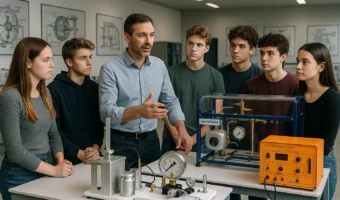
The equipment described forms a synergistic teaching set that allows students to explore, through direct experience, the fundamentals of metrology applied to thermodynamics. Students thus acquire practical skills of value in the professional world, improving their ability to measure, interpret and control thermo-fluid dynamic phenomena. The ability to integrate hardware and software makes this lab highly educational and in line with the needs of Industry 4.0. This solution includes technology systems that help foster inclusion and equal opportunities through innovative teaching methods. It is designed to promote active, collaborative learning.
Other solutions for: