About this solution
Lab Objectives
Ideal gas expansion processes
- Understand the thermodynamic transformations of an ideal gas, in particular expansion and compression processes.
- Analyse the behaviour of air in vessels subjected to pressure and vacuum, assessing changes in temperature and pressure.
- Use digital sensors to measure the physical properties of the gas in real time during the transformation.
- Introduce the concept of equations of state and their practical application in controlled experiments. Film and dropwise condensation unit
- Visualise directly and intuitively the two main steam condensation phenomena: continuous film and dropwise.
- Study the influence of temperature, pressure, vacuum and air flow on condensation processes.
- Develop the ability to carry out thermodynamic calculations on energy balance and the efficiency of heat exchange processes.
- Acquire instrumental skills for recording, managing and analysing data collected through sensors and dedicated software.
Educational Aims
- Promote active learning of applied thermodynamics through direct, measurable experiences.
- Encourage understanding of the microscopic and macroscopic mechanisms involved in converting heat into work and vice versa.
- Support the acquisition of digital and experimental skills through the use of software for recording and analysing data.
- Offer useful tools for assessing real industrial processes, such as cooling and humidity control in refrigeration and air-conditioning systems.
Conclusion
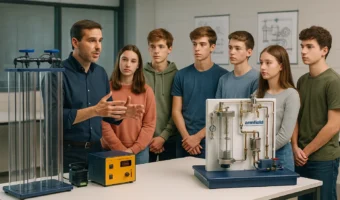
The equipment described makes it possible to explore the fundamental principles of gas thermodynamics and heat transfer rigorously and clearly, highlighting the relationship between theory and practice. With modern acquisition technology and integrated safety, the units enable effective and safe learning, making students active protagonists in the lab. The visual and analytical approach to physical phenomena prepares them for the professional challenges of the energy, environmental and building services sectors, with solid technical and methodological foundations. This solution includes technology systems that help foster inclusion and equal opportunities through innovative teaching methods. It is designed to promote active, collaborative learning.
Other solutions for: