About this solution
Lab Objectives
- Understand indirect heat exchange techniques in fluids Students become familiar with the physical and design principles underlying heat exchange between two fluids through solid walls, in counterflow, parallel-flow, crossflow and multi-pass configurations.
- Test the thermal behaviour of different types of heat exchanger The exercises use tubular, plate, shell-and-tube, jacketed and crossflow exchangers and extended modular configurations, making it possible to observe the thermal response of each model under varying conditions.
- Use measuring instruments to acquire thermal data The activities use thermocouples, educational software, digital interfaces and multiple measuring points to analyse heat exchange efficiency and temperature distribution in real time.
- Compare different engineering configurations Students can modify modular configurations (as with the reconfigurable plate exchangers) to observe the influence of exchange surface area, number of passes and agitation on heat transfer processes.
- Reflect on the industrial application of heat exchangers Hands-on experience links thermodynamic principles to operating reality in the food, chemical, HVAC and automotive sectors, where the same devices are used on a larger scale.
Educational Aims
- Integrate theory and practice in the study of industrial thermal processes The lab makes it possible to apply fundamental concepts of thermodynamics and heat transfer to real situations, supporting experiential learning.
- Develop technical skills in heat monitoring and control Students learn to take measurements, analyse experimental data and interpret results in terms of exchange efficiency, improving their skills in process control settings.
- Encourage energy design and optimisation Comparative analysis of different exchangers prompts reflection on the most suitable solutions according to fluid type, configuration, footprint and energy requirements.
- Promote flexibility and interdisciplinarity The modular equipment allows cross-curricular exercises spanning mechanics, energy, chemistry and automation, with potential use in work-based learning (PCTO) or multidisciplinary projects.
Conclusion
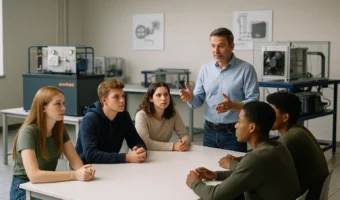
The heat exchanger equipment forms a highly educational lab for students at Technical Institutes on the “Mechanics, Mechatronics and Energy” and “Chemistry, Materials and Biotechnology” tracks, as well as for vocational courses in building services and thermal engineering. The modularity of the systems — combined with computerised measurement and control instruments — allows extensive customisation of teaching and realistic simulation of industrial plants, making students active protagonists in experimenting with, designing and understanding modern energy technologies. This solution includes technology systems that help foster inclusion and equal opportunities through innovative teaching methods. It is designed to promote active, collaborative learning.
Other solutions for: