About this solution
Objectives
1. Understand the structure and risks of electrical systems
Students analyse the architecture of power supply systems, identifying the risks of overload, short circuit and overvoltage, and assessing the most suitable protective measures in different scenarios.
2. Assess protective measures in different network systems
The lab makes it possible to compare protection solutions for TN-C, TN-S, TT and IT configurations, following DIN VDE 0100 standards and directly testing the results of real configurations.
3. Analyse the effects of current on the human body
The physiological effects of current are covered, with reference to the heart current factor, touch and fault voltages, and the life-saving measures to be taken in the event of an electrical accident.
4. Measure and test electrical safety
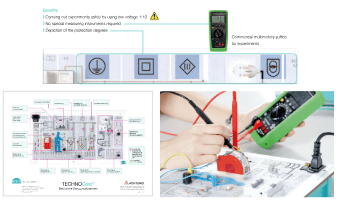
Students carry out real tests on simulated installations to check the effectiveness of residual current devices, fuses, electrical separation and SELV/PELV systems, using digital instruments and professional multimeters.
Learning Aims
1. Develop awareness of electrical risks
Through the training package, students learn to recognise critical issues in electrical installations and to design solutions that comply with current safety regulations.
2. Acquire technical and regulatory skills
The lab makes it possible to apply VDE directives in practice, understanding the logic of protection systems, component sizing and installation testing.
3. Work safely on installations
Thanks to low-voltage simulations, students can practise measurement and maintenance work without risk, following professional safety rules.
4. Document and analyse experimental results
The manuals include measurement tables, network diagrams and test data that make it possible to document lab experiments and assess their effectiveness in educational and technical terms.
Simulation Functions
Integrated measurement system and realistic simulation
The station includes simulations of TN, TT and IT connections, measurements with 30 mA RCDs, isolating transformers, tests on faults and earth leakage, and LED indicators for when the touch voltage is exceeded.
Analysis of step voltage and leakage
The experimental panel makes it possible to simulate step voltages and voltage gradients, providing a practical understanding of risk conditions and mitigation techniques such as equipotential bonding.
Other solutions for: