About this solution
Objectives
1. Understand the architectures of electrical systems
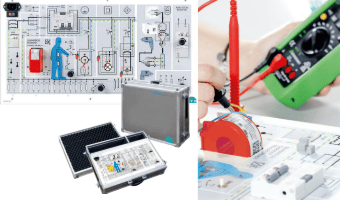
Students analyse the structure of both the public grid and consumer installations, exploring the configuration of TN, TT and IT networks using real devices such as meters, RCDs, distribution boards and fault simulators.
2. Apply protective measures and tests in accordance with standards
The system allows protective measures to be selected and verified through practical tests in accordance with DIN VDE 0100-600, 0100-410 and DGUV-V3, with support for simulated faults and impedance, insulation and loop measurements.
3. Carry out initial and periodic tests
Learning activities include realistic tests on complete installations, documentation of results using standardised test reports and the use of professional field instruments such as multifunction testers with Wi-Fi and touch screen.
4. Develop complete technical skills
Through exercises on flush-mounted installation, the use of selective type A, B and F RCDs, and advanced instruments for testing phase rotation, touch voltage and surge protection, students are prepared to carry out installations and field checks independently.
Learning Aims
1. Combine practice and regulations in the electrical field
The package allows students to work on real devices, simulating realistic scenarios with common faults and network structures, encouraging active learning of technical standards and safety protocols.
2. Develop autonomy in testing installations
The modular, progressive approach trains students to choose the right instruments, interpret results and draw up complete test reports according to industry standards.
3. Simulate a complete real domestic installation
The BST® environment brings together walls, sub-distribution boards, junction boxes, panels, protective devices and instruments for a realistic simulation of three-storey installations, useful for installation, measurement and testing activities.
4. Train in prevention and maintenance
Through periodic tests and the detection of simulated fault conditions, students learn the importance of preventive maintenance and of bringing existing installations up to standard.
Other solutions for: