About this solution
Objectives
1. Understand the role of the neutral conductor in three-phase systems
Students analyse star circuit configurations, exploring the differences between balanced and unbalanced systems and the dynamic behaviour of the neutral conductor. Particular attention is paid to phenomena that can lead to neutral overload, especially in the presence of electronic loads that generate distorted currents. Practical exercises help students visualise current flow and understand the balance between phases.
2. Recognise and analyse harmonics
The module introduces the concept of harmonics, their origin in non-linear loads (such as switch-mode power supplies, LED lamps and inverters) and the way they affect the current waveform. Students learn to identify odd harmonics and triplen harmonics, which add up in the neutral, causing thermal overload and system degradation. Activities include the use of software for spectral visualisation and data interpretation.
3. Take measurements with professional instruments
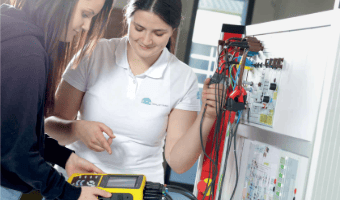
Students practise using network analysers, digital oscilloscopes and TRMS clamp meters to take accurate measurements on real or simulated systems. Voltage and current tests are carried out on all three phases and the neutral, assessing parameters such as power factor, total harmonic distortion (THD) and phase imbalance. The aim is for students to become independent in identifying anomalies and correctly interpreting instrument data.
4. Develop awareness of installation safety
Through the analysis of real cases and simulations, students understand the safety implications of an overloaded or undersized neutral conductor. Consequences such as conductor overheating, nuisance tripping of protective devices, earth faults and loss of system functionality are examined in depth. The aim is to build a culture of informed design in compliance with CEI and IEC standards.
Learning Aims
1. Combine theory and practice in technical training
The course combines in-depth theoretical explanations with structured practical exercises, with the aim of building complete, operational knowledge. Students immediately apply what they have learnt in lab activities, working on case studies and teaching installations that reproduce real conditions. This fosters solid, lasting learning, ready to be transferred to the world of work.
2. Prepare students to use modern instruments
One of the learning objectives is to make students proficient in the use of advanced instruments for measuring and analysing power quality. In addition to basic techniques, functions such as harmonic analysis, event recording and energy diagnostics are explored. This approach prepares students for high-tech working environments such as industrial automation and predictive maintenance.
3. Teach fault prevention
The module aims to develop the ability to recognise early warning signs of electrical malfunctions, analysing data and symptoms critically. Work focuses on identifying imbalances, harmonics and anomalies which, if neglected, can lead to service interruptions or damage to installations. The aim is to promote proactive, responsible maintenance that prevents faults rather than simply repairing them.
4. Encourage critical thinking and the analysis of electrical phenomena
In addition to technical skills, the pathway develops analytical and decision-making abilities. Students learn to compare theoretical and experimental data, evaluate different hypotheses and choose effective, safe design solutions. Actively observing electrical phenomena and processing the results fosters a reflective attitude, which is essential in technical and professional fields.
Other solutions for: